Where culture decides, culture buys.
Analysing the behavioural forces shaping consumer purchase decisions in Japan's streetwear industry, offline and online.
Industry: Fashion
Year: 2024
Brands: BAPE (& more)
↓
Industry: Fashion
Year: 2024
Brand: BAPE (& more)
↓
Industry: Fashion
↓
The story.
The story.
What does it take to make a consumer stop, look, and buy in a market where tradition and trend collide?
Japan's fashion industry in 2023 sits at ¥13 trillion (€104 billion), among the largest in Asia, and within it, streetwear alone accounts for ¥2.5 trillion (€21.7 billion).
By 2026, that figure is expected to climb to ¥5.36 trillion (€31 billion).
Brands like BAPE, Neighbourhood, and Undercover compete on meaning, rather than price or product features. Every limited-edition drop, every sold-out release, every collaboration, is about what wearing it says about YOU.
Of course, behind every limited-edition drop and sold-out collection is something most brands never think about: the psychology of the person buying it.
That is what this research is about.
Consumers here buy identity, status, and belonging. They do it across physical stores and late night Instagram or TikTok scrolls often within the same purchase journey.
The decision to buy is RARELY impulsive. It is earned through trust, reputation, and the right moment.
So the question I kept coming back to was: What creates that moment? What can a brand do to be ready for it?
(If you are still reading this, you probably already know the answer matters. And that, dear stranger, is exactly what I set out to find).
What does it take to make a consumer stop, look, and buy in a market where tradition and trend collide?
Japan's fashion industry in 2023 sits at ¥13 trillion (€104 billion), among the largest in Asia, and within it, streetwear alone accounts for ¥2.5 trillion (€21.7 billion).
By 2026, that figure is expected to climb to ¥5.36 trillion (€31 billion).
Brands like BAPE, Neighbourhood, and Undercover compete on meaning, rather than price or product features. Every limited-edition drop, every sold-out release, every collaboration, is about what wearing it says about YOU.
Of course, behind every limited-edition drop and sold-out collection is something most brands never think about: the psychology of the person buying it.
That is what this research is about.
Consumers here buy identity, status, and belonging. They do it across physical stores and late night Instagram or TikTok scrolls often within the same purchase journey.
The decision to buy is RARELY impulsive. It is earned through trust, reputation, and the right moment.
So the question I kept coming back to was: What creates that moment? What can a brand do to be ready for it?
(If you are still reading this, you probably already know the answer matters. And that, dear stranger, is exactly what I set out to find).
The question.
The question.
As you probably already know, a piece of research starts with the right questions. These were mine.
What drives a Japanese streetwear consumer to choose one brand over another, across both physical stores and online platforms?
What role do social influence, cultural identity, and psychology play in building brand loyalty in this market?
What does a brand need to truly understand about its consumer before spending a single € on marketing?
If you just skimmed these three questions and one of them made you pause, that is the one your brand needs to answer.
Market data alone could not get me there. Numbers tell you what is happening. They rarely tell you why. So instead of starting with spreadsheets, I started with people.
I built two buyer personas rooted in Tokyo streetwear culture. Two people navigating the same market in completely different ways, with different budgets, different motivations, and different breaking points.
Their behaviours, frustrations, and motivations became the lens through which every model, every framework, and every insight in this research was tested.
You cannot market to everyone. But you DEFINITELY can understand someone so well that everything you do feels personal to them.
As you probably already know, a piece of research starts with the right questions. These were mine.
What drives a Japanese streetwear consumer to choose one brand over another, across both physical stores and online platforms?
What role do social influence, cultural identity, and psychology play in building brand loyalty in this market?
What does a brand need to truly understand about its consumer before spending a single € on marketing?
If you just skimmed these three questions and one of them made you pause, that is the one your brand needs to answer.
Market data alone could not get me there. Numbers tell you what is happening. They rarely tell you why. So instead of starting with spreadsheets, I started with people.
I built two buyer personas rooted in Tokyo streetwear culture. Two people navigating the same market in completely different ways, with different budgets, different motivations, and different breaking points.
Their behaviours, frustrations, and motivations became the lens through which every model, every framework, and every insight in this research was tested.
You cannot market to everyone. But you DEFINITELY can understand someone so well that everything you do feels personal to them.
The rise of digital channels has fundamentally changed how audiences discover, engage with, and evaluate cultural institutions.
Heritage Malta historically relied on physical presence and traditional communications to connect with its audience.
Pre-pandemic, there was limited dedicated digital expertise. The pandemic accelerated change, prompting the organisation to invest in digital marketing professionals and social media platforms, marking a new chapter in its engagement strategy.
This project explored a simple, yet critical question:
How have digital technologies transformed audience behaviour and institutional relevance for Heritage Malta?
To answer this, a mixed-methods approach combined surveys, interviews, and platform analysis.
The aim was not only to collect data, but to find patterns in how audiences interact with heritage digitally, and how these patterns inform strategic decisions about communication, engagement, and long-term relevance.
The approach.
The approach.
Every research project lives or dies by the framework behind it.
To understand the Japanese streetwear consumer, I needed a structure that could hold the complexity of two very different shopping worlds. The physical store and the 2am scroll through an app. The same person, two completely different headspaces, two completely different triggers.
So before I looked at what people buy, I asked myself a more important question: who actually makes the decision?
Every research project lives or dies by the framework behind it.
To understand the Japanese streetwear consumer, I needed a structure that could hold the complexity of two very different shopping worlds. The physical store and the 2am scroll through an app. The same person, two completely different headspaces, two completely different triggers.
So before I looked at what people buy, I asked myself a more important question: who actually makes the decision?
The rise of digital channels has fundamentally changed how audiences discover, engage with, and evaluate cultural institutions.
Heritage Malta historically relied on physical presence and traditional communications to connect with its audience.
Pre-pandemic, there was limited dedicated digital expertise. The pandemic accelerated change, prompting the organisation to invest in digital marketing professionals and social media platforms, marking a new chapter in its engagement strategy.
This project explored a simple, yet critical question:
How have digital technologies transformed audience behaviour and institutional relevance for Heritage Malta?
To answer this, a mixed-methods approach combined surveys, interviews, and platform analysis.
The aim was not only to collect data, but to find patterns in how audiences interact with heritage digitally, and how these patterns inform strategic decisions about communication, engagement, and long-term relevance.
| The decision-making unit (DMU).
| The decision-making unit (DMU).
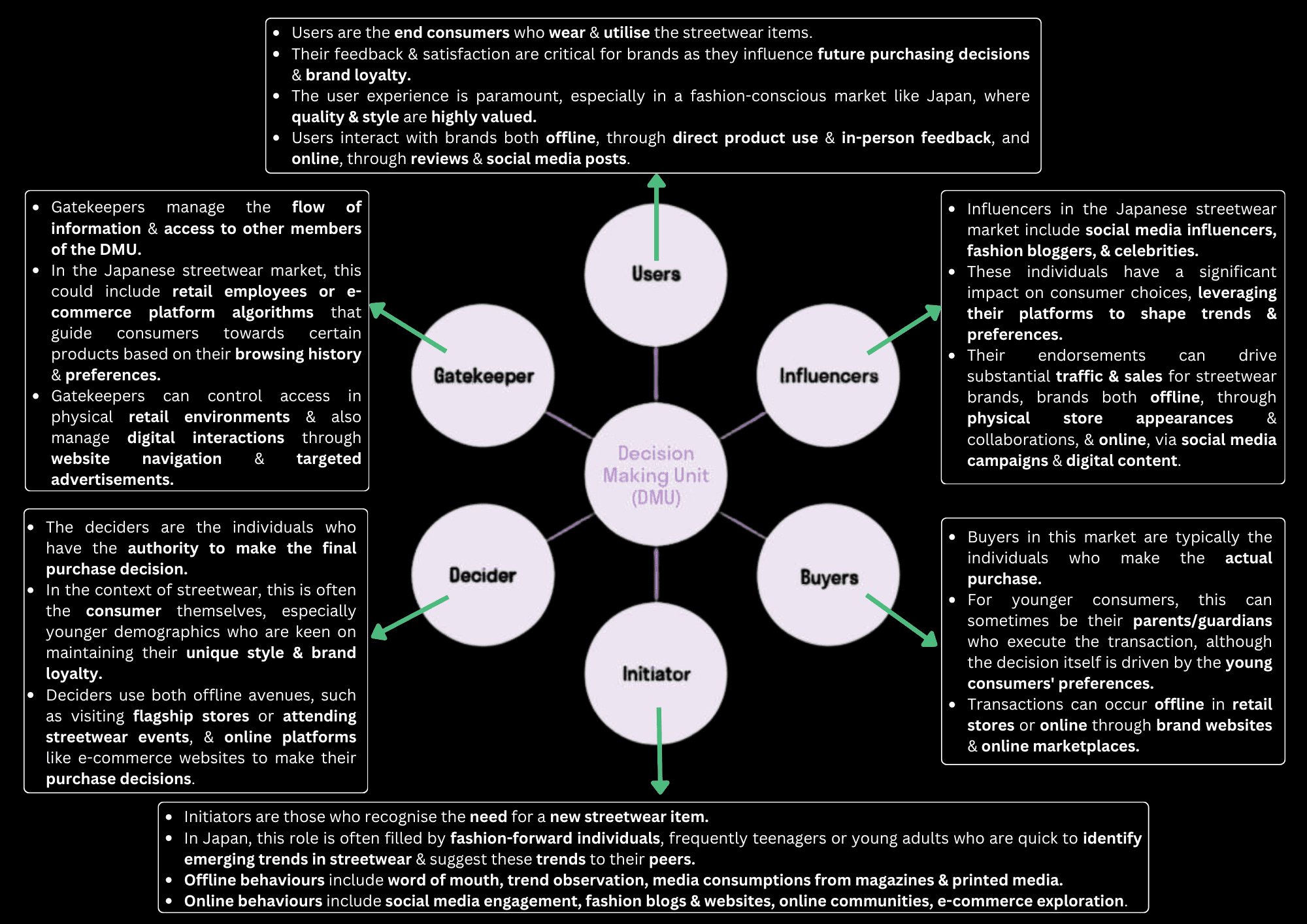
In Japanese streetwear, a purchase is rarely made by one person acting alone.
The DMU framework (by Stanford University) maps the 6 roles that shape every transaction.
The initiator who spots the trend.
The gatekeeper who controls what information gets through.
The buyer who pays.
The decider who commits.
The influencer who validates the decision.
The user who wears it.
Think of the DMU as the cast of characters. Every purchase has one, whether the brand knows it or not.
But knowing who is in the room is only half the story. The decision-making process is what happens when those people start interacting. It is the conversation, the back and forth, the moment someone sees a BAPE drop on Instagram and sends it to their friend group for validation before committing.
The decision-making unit tells you who matters.
The decision-making process tells you how they influence each other.
In Japanese streetwear, a purchase is rarely made by one person acting alone.
The DMU framework (by Stanford University) maps the 6 roles that shape every transaction.
The initiator who spots the trend.
The gatekeeper who controls what information gets through.
The buyer who pays.
The decider who commits.
The influencer who validates the decision.
The user who wears it.
Think of the DMU as the cast of characters. Every purchase has one, whether the brand knows it or not.
But knowing who is in the room is only half the story. The decision-making process is what happens when those people start interacting. It is the conversation, the back and forth, the moment someone sees a BAPE drop on Instagram and sends it to their friend group for validation before committing.
The decision-making unit tells you who matters.
The decision-making process tells you how they influence each other.
The rise of digital channels has fundamentally changed how audiences discover, engage with, and evaluate cultural institutions.
Heritage Malta historically relied on physical presence and traditional communications to connect with its audience.
Pre-pandemic, there was limited dedicated digital expertise. The pandemic accelerated change, prompting the organisation to invest in digital marketing professionals and social media platforms, marking a new chapter in its engagement strategy.
This project explored a simple, yet critical question:
How have digital technologies transformed audience behaviour and institutional relevance for Heritage Malta?
To answer this, a mixed-methods approach combined surveys, interviews, and platform analysis.
The aim was not only to collect data, but to find patterns in how audiences interact with heritage digitally, and how these patterns inform strategic decisions about communication, engagement, and long-term relevance.
| The decision-making process (DMP) & models.
| The decision-making process (DMP) & models.
Every purchase starts long before a consumer reaches the checkout.
According to UMass Dartmouth (2024), the decision-making process covers 7 stages:
identify the decision
gather relevant information
identify alternatives
weigh the evidence
choose among alternatives
take action
review your decision
Every purchase starts long before a consumer reaches the checkout.
According to UMass Dartmouth (2024), the decision-making process covers 7 stages:
identify the decision
gather relevant information
identify alternatives
weigh the evidence
choose among alternatives
take action
review your decision
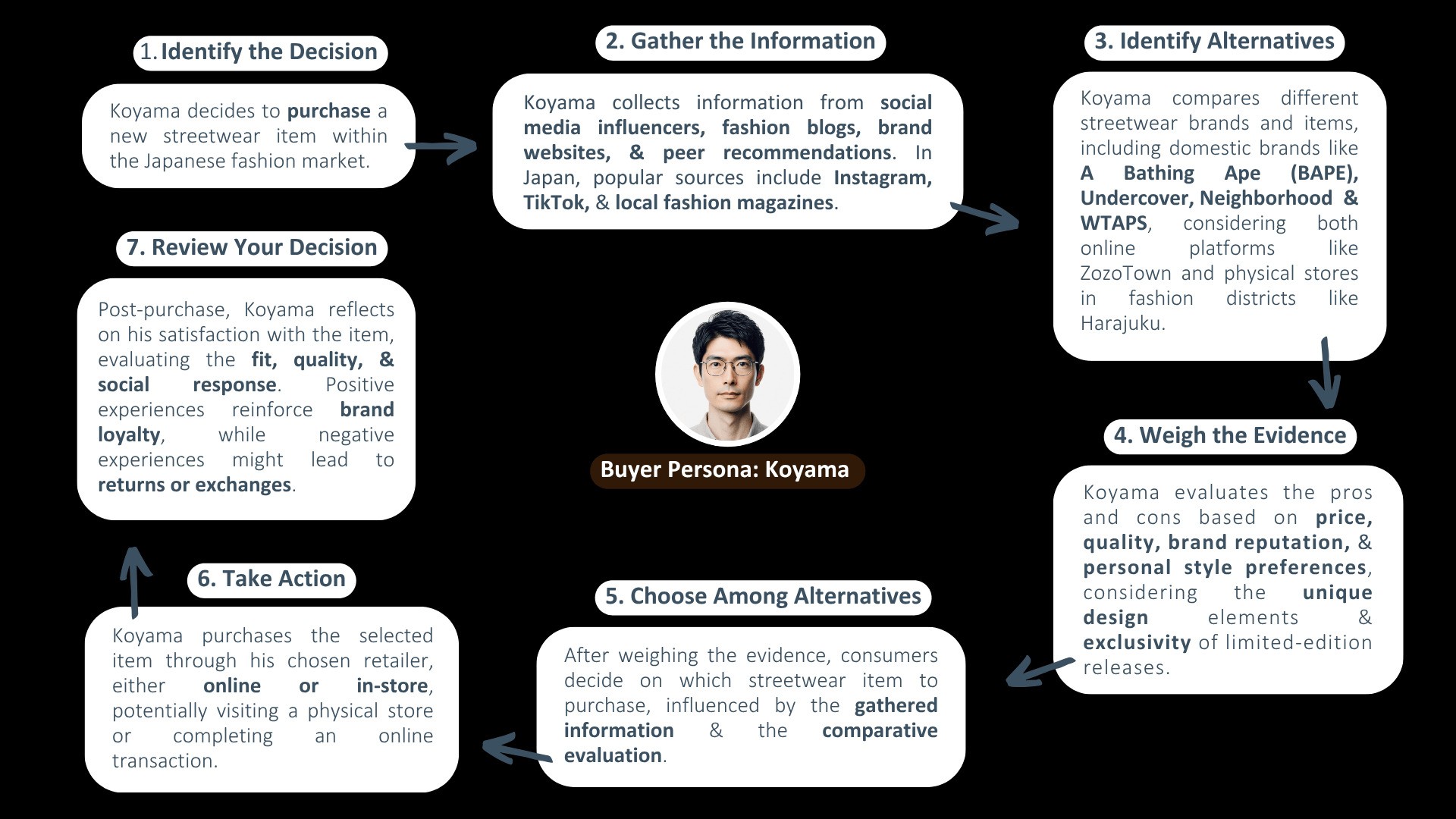
Now here is where MOST research stops. They map the stages and call it done. But knowing the stages tells you what happens. It does not tell you why. That is the gap I wanted to close.
So I applied three decision making models, each chosen to answer a different question about the same consumer.
The EKB model.
Ashman, Koltat and Blackwell in 1968 mapped something that every marketer should know by heart.
A consumer never just buys. They move through a journey: recognising a need, searching for information, comparing options, making a choice, purchasing, and then evaluating whether it was worth it.
In the Japanese streetwear market, that journey is rarely straightforward. Koyama sees an Undercover drop on Instagram. He searches for reviews, compares prices, checks sizing guides, abandons the checkout twice, and finally commits. The purchase took seconds. The journey took days.
That gap between desire and decision is where brands win or lose.
Now here is where MOST research stops. They map the stages and call it done. But knowing the stages tells you what happens. It does not tell you why. That is the gap I wanted to close.
So I applied three decision making models, each chosen to answer a different question about the same consumer.
The EKB model.
Ashman, Koltat and Blackwell in 1968 mapped something that every marketer should know by heart.
A consumer never just buys. They move through a journey: recognising a need, searching for information, comparing options, making a choice, purchasing, and then evaluating whether it was worth it.
In the Japanese streetwear market, that journey is rarely straightforward. Koyama sees an Undercover drop on Instagram. He searches for reviews, compares prices, checks sizing guides, abandons the checkout twice, and finally commits. The purchase took seconds. The journey took days.
That gap between desire and decision is where brands win or lose.
Now here is where MOST research stops. They map the stages and call it done. But knowing the stages tells you what happens. It does not tell you why. That is the gap I wanted to close.
So I applied three decision making models, each chosen to answer a different question about the same consumer.
The EKB model.
Ashman, Koltat and Blackwell in 1968 mapped something that every marketer should know by heart.
A consumer never just buys. They move through a journey: recognising a need, searching for information, comparing options, making a choice, purchasing, and then evaluating whether it was worth it.
In the Japanese streetwear market, that journey is rarely straightforward. Koyama sees an Undercover drop on Instagram. He searches for reviews, compares prices, checks sizing guides, abandons the checkout twice, and finally commits. The purchase took seconds. The journey took days.
That gap between desire and decision is where brands win or lose.
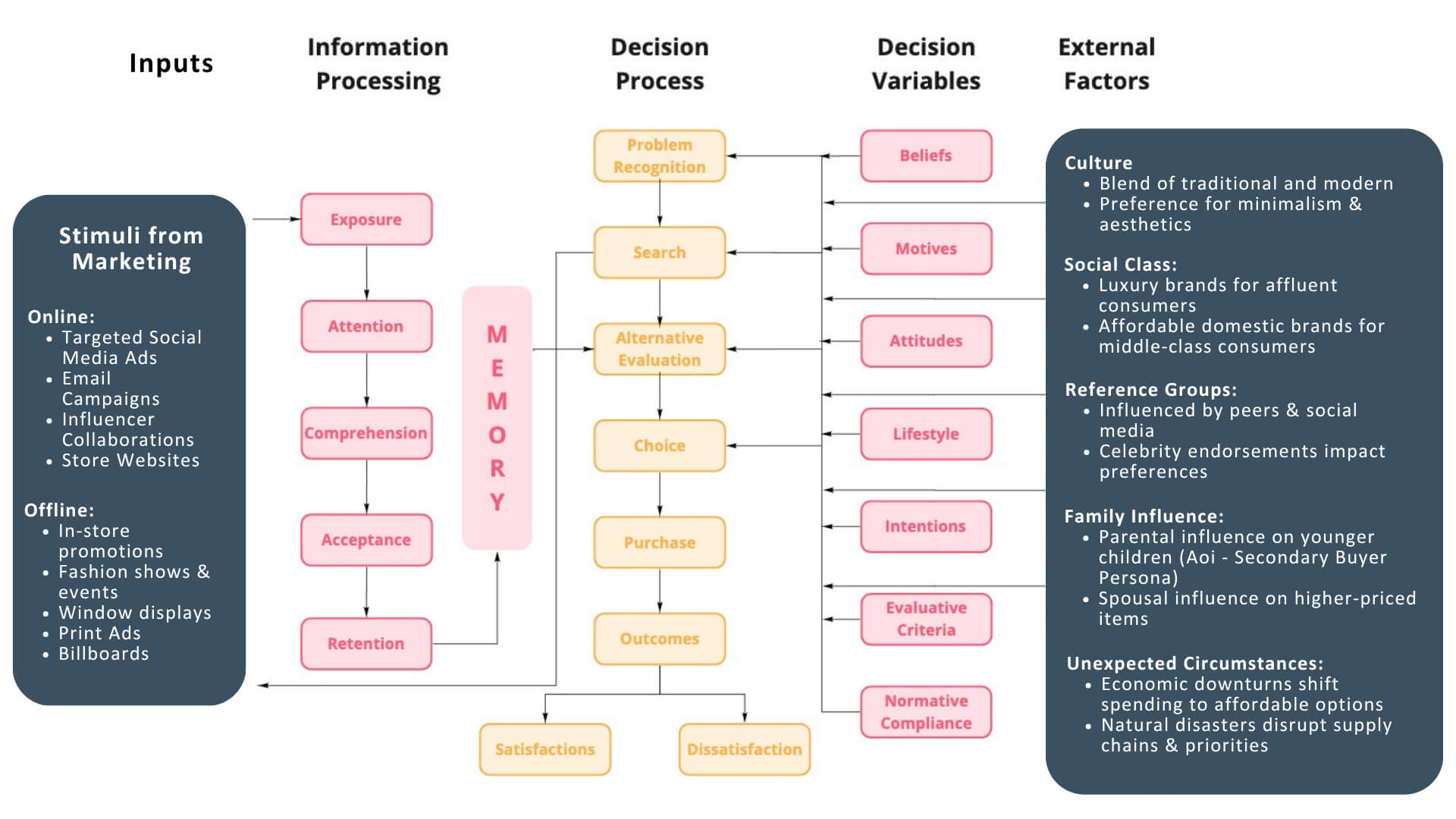
So the EKB Model shows me the journey, but it does not show me what is happening inside the consumer's head along the way (that is where the next model comes in).
So the EKB Model shows me the journey, but it does not show me what is happening inside the consumer's head along the way (that is where the next model comes in).
So the EKB Model shows me the journey, but it does not show me what is happening inside the consumer's head along the way (that is where the next model comes in).
The Pavlovian model.
Ivan Pavlov, a Russian physiologist, discovered conditioned behaviour through a simple experiment. He rang a bell, presented a dog with meat, and measured the saliva produced. Over time, the dog salivated at the sound of the bell alone. The stimulus had become enough.
This sits at the heart of the learning model of consumer behaviour, and is exactly how the most successful streetwear brands in Japan operate.
Every limited edition drop is a stimulus.
Every sold out release creates desire.
Every influencer endorsement delivers validation.
Repeat the cycle enough times and the consumer stops consciously deciding. The response becomes automatic. BAPE has been doing this for decades.
Most people think that the loyalty it commands is accidental. Trust me, it's ALL engineered.
The Pavlovian model.
Ivan Pavlov, a Russian physiologist, discovered conditioned behaviour through a simple experiment. He rang a bell, presented a dog with meat, and measured the saliva produced. Over time, the dog salivated at the sound of the bell alone. The stimulus had become enough.
This sits at the heart of the learning model of consumer behaviour, and is exactly how the most successful streetwear brands in Japan operate.
Every limited edition drop is a stimulus.
Every sold out release creates desire.
Every influencer endorsement delivers validation.
Repeat the cycle enough times and the consumer stops consciously deciding. The response becomes automatic. BAPE has been doing this for decades.
Most people think that the loyalty it commands is accidental. Trust me, it's ALL engineered.
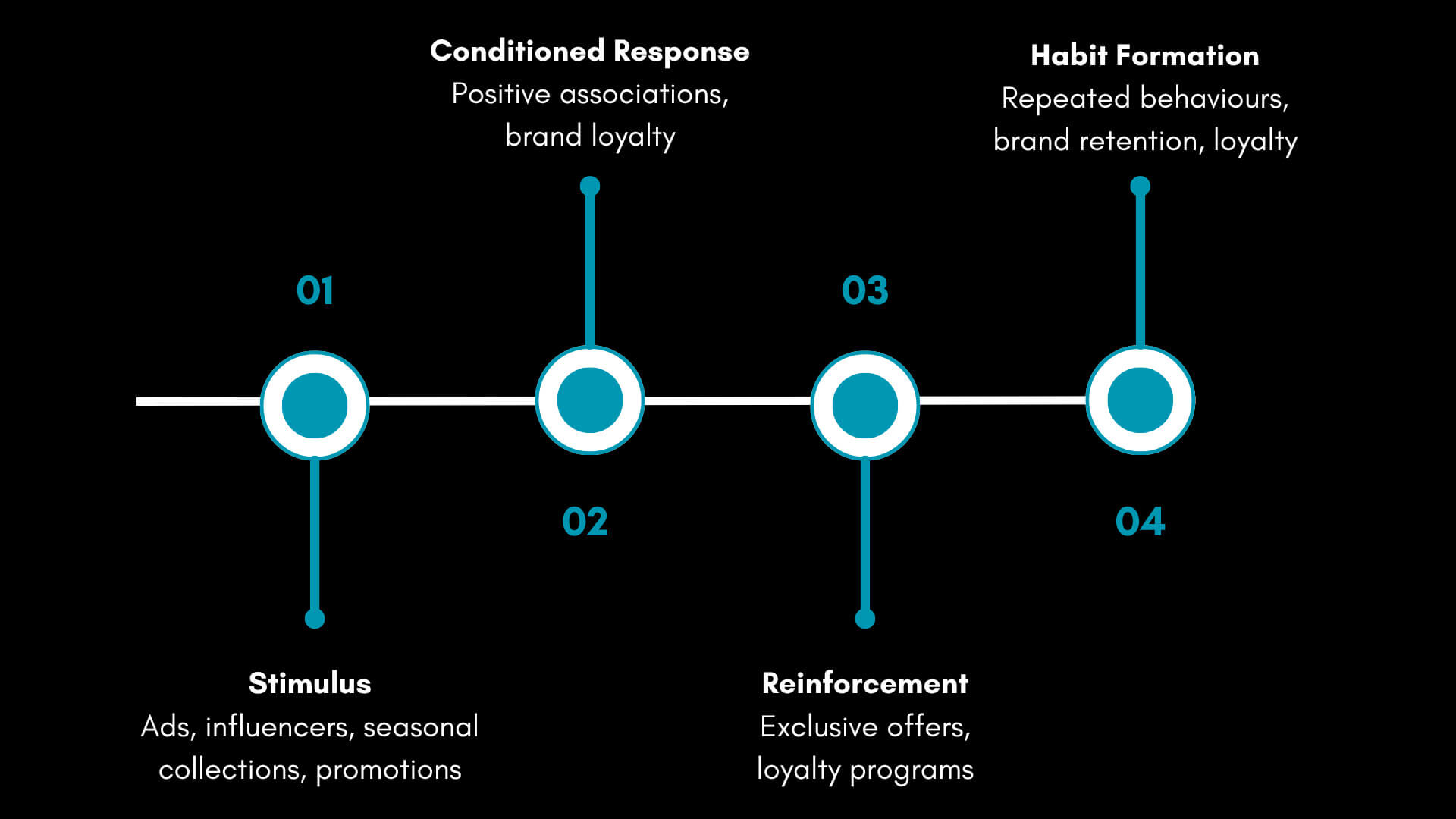
So this conditioning explains how loyalty is built over time. However, it does not explain what shapes a consumer's perception before the cycle even begins. That is the final piece to this puzzle.
So this conditioning explains how loyalty is built over time. However, it does not explain what shapes a consumer's perception before the cycle even begins. That is the final piece to this puzzle.
So this conditioning explains how loyalty is built over time. However, it does not explain what shapes a consumer's perception before the cycle even begins. That is the final piece to this puzzle.
The Howard Sheth model.
Haines, Howard and Sheth argued that every purchase decision starts long before a consumer enters a store or opens an app. It starts with inputs. What they see, what they hear, and what the people around them say.
In Japan, those inputs carry extra weight.
A BAPE logo on a store front carries meaning.
A Comme des Garçons collaboration shared by the right influencer carries status.
A peer recommendation carries trust.
These signals stack up over time, shaping perception, attitude, and eventually, the decision to buy.
By the time a Japanese streetwear consumer reaches the checkout, the decision has already been made. The brand either earned it or lost it long before that moment.
The Howard Sheth model.
Haines, Howard and Sheth argued that every purchase decision starts long before a consumer enters a store or opens an app. It starts with inputs. What they see, what they hear, and what the people around them say.
In Japan, those inputs carry extra weight.
A BAPE logo on a store front carries meaning.
A Comme des Garçons collaboration shared by the right influencer carries status.
A peer recommendation carries trust.
These signals stack up over time, shaping perception, attitude, and eventually, the decision to buy.
By the time a Japanese streetwear consumer reaches the checkout, the decision has already been made. The brand either earned it or lost it long before that moment.
The Howard Sheth model.
Haines, Howard and Sheth argued that every purchase decision starts long before a consumer enters a store or opens an app. It starts with inputs. What they see, what they hear, and what the people around them say.
In Japan, those inputs carry extra weight.
A BAPE logo on a store front carries meaning.
A Comme des Garçons collaboration shared by the right influencer carries status.
A peer recommendation carries trust.
These signals stack up over time, shaping perception, attitude, and eventually, the decision to buy.
By the time a Japanese streetwear consumer reaches the checkout, the decision has already been made. The brand either earned it or lost it long before that moment.
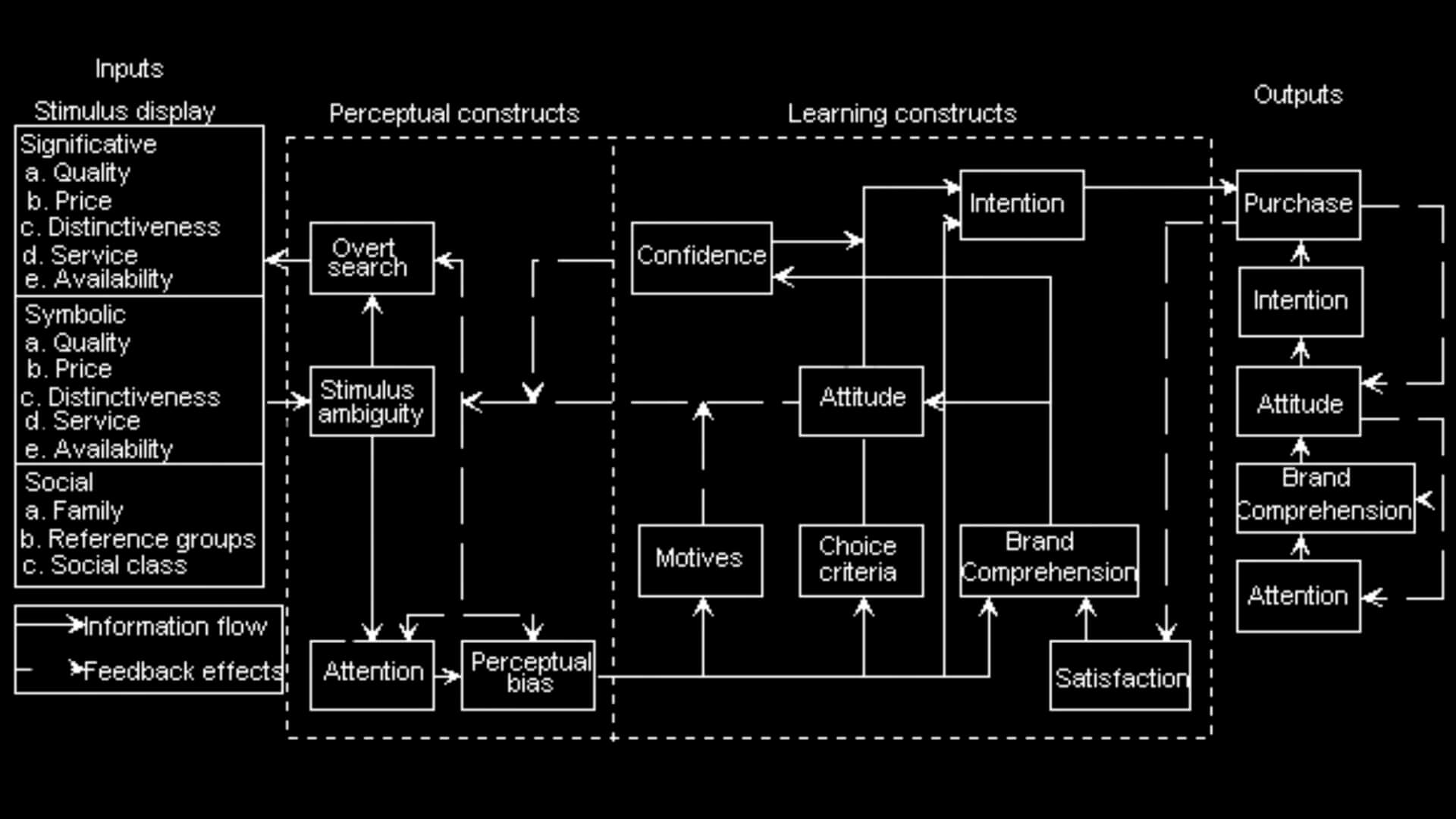
Three models. Three different lenses on the same consumer.
The EKB Model shows me where in the journey a brand can win or lose a consumer.
The Pavlovian Model shows me how loyalty is conditioned over time.
The Howard Sheth Model shows me what inputs are shaping perception before the consumer even realises they are making a decision.
This gives a complete picture of how a Japanese streetwear consumer thinks, feels, and ultimately buys. No single model could do that alone.
You might ask me: you spoke about all of these models, but what do they REALLY show?
Three models. Three different lenses on the same consumer.
The EKB Model shows me where in the journey a brand can win or lose a consumer.
The Pavlovian Model shows me how loyalty is conditioned over time.
The Howard Sheth Model shows me what inputs are shaping perception before the consumer even realises they are making a decision.
This gives a complete picture of how a Japanese streetwear consumer thinks, feels, and ultimately buys. No single model could do that alone.
You might ask me: you spoke about all of these models, but what do they REALLY show?
Three models. Three different lenses on the same consumer.
The EKB Model shows me where in the journey a brand can win or lose a consumer.
The Pavlovian Model shows me how loyalty is conditioned over time.
The Howard Sheth Model shows me what inputs are shaping perception before the consumer even realises they are making a decision.
This gives a complete picture of how a Japanese streetwear consumer thinks, feels, and ultimately buys. No single model could do that alone.
You might ask me: you spoke about all of these models, but what do they REALLY show?

I will get there. But before I do, there is one last thing I needed to do. Put a human face on all of it.
| The buyer personas.
All of these frameworks needed a human face. So let me introduce you to the two people this entire research was built around.
Rather than working from broad demographics, I constructed two personas representing the most significant consumer profiles in this market. Every model, every framework, and every insight you have read so far was tested against how these two people actually think, feel, and shop.
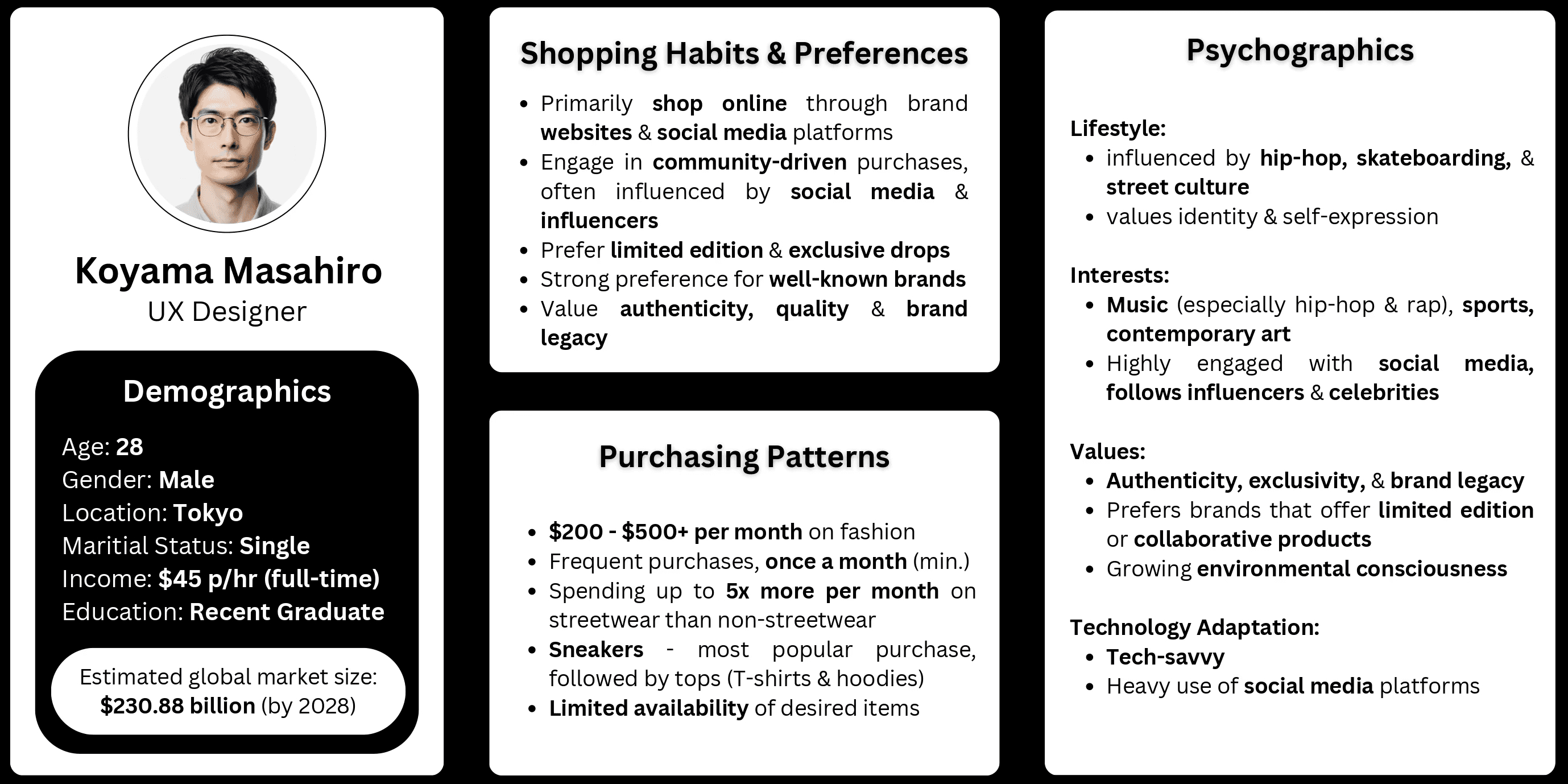
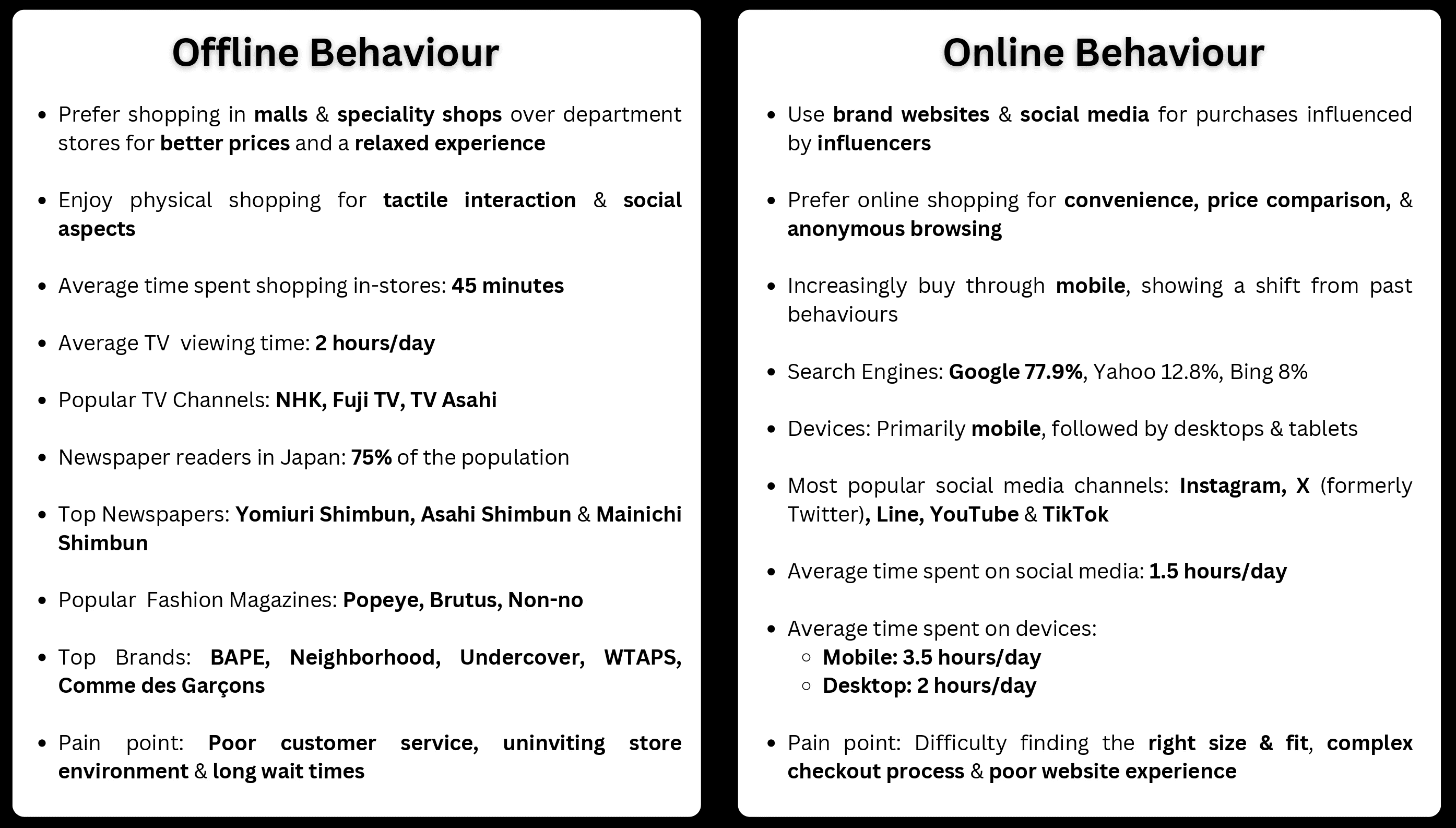
Buyer Persona 1 | Koyama Masahiro
28, a UX designer in Tokyo, spending $200–500 monthly on streetwear. He shops both online and in-store, values authenticity and brand legacy above everything, and follows influencers who align with his identity.
He's deliberate. He knows what he wants and why he wants it.
Buyer Persona 2 | Aoi Tanaka
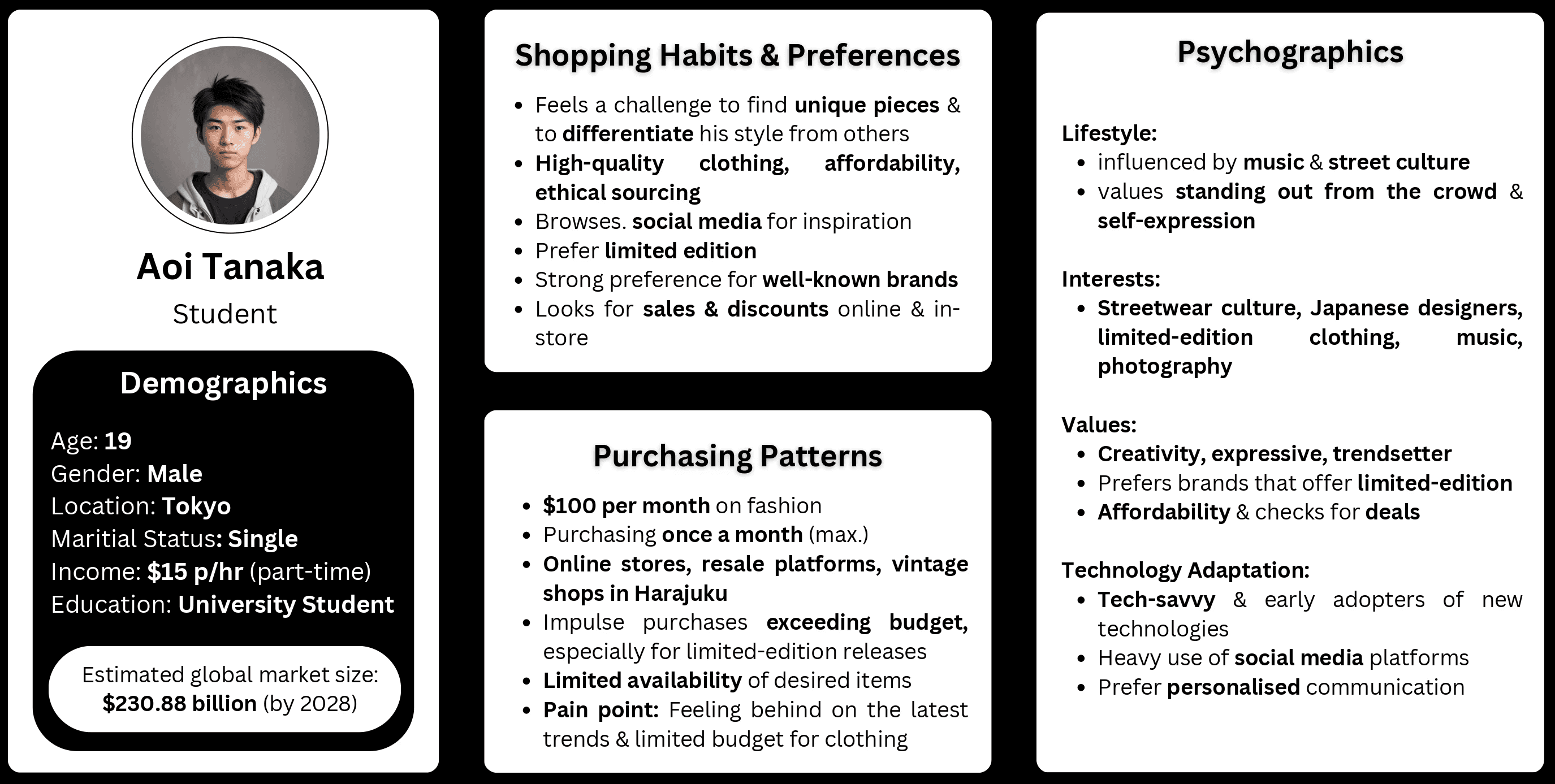
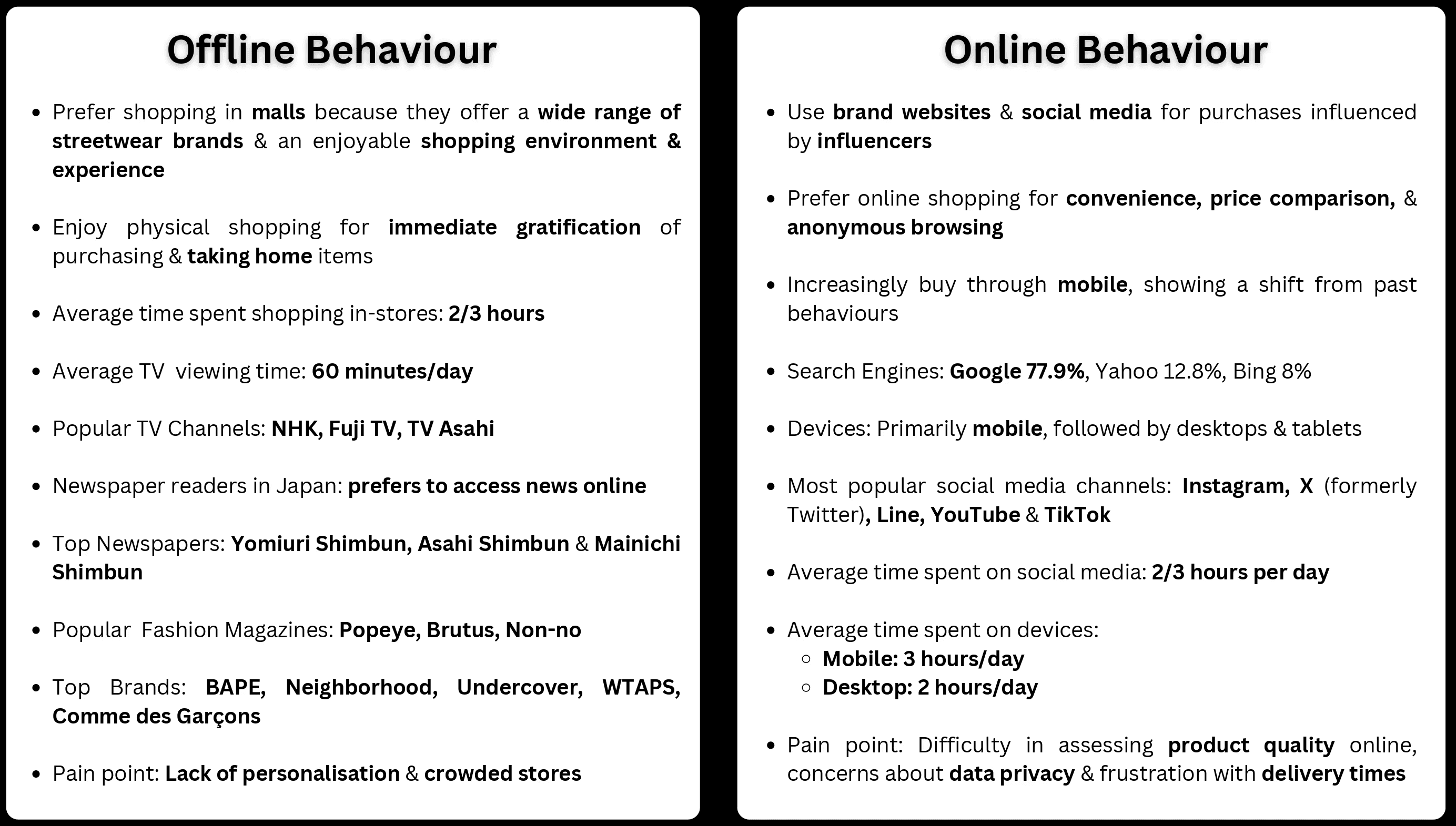
19, student, spending around $100 monthly. He's impulsive, trend-driven, and motivated by the fear of missing out.
He discovers everything on social media and buys before he has time to overthink it.
2 people. 1 market. Very different behaviours.
Every answer I found looked completely different depending on which one I was looking at. And if one of them reminds you of your own customer, keep reading.
I will get there. But before I do, there is one last thing I needed to do. Put a human face on all of it.
| The buyer personas.
All of these frameworks needed a human face. So let me introduce you to the two people this entire research was built around.
Rather than working from broad demographics, I constructed two personas representing the most significant consumer profiles in this market. Every model, every framework, and every insight you have read so far was tested against how these two people actually think, feel, and shop.
Buyer Persona 1 | Koyama Masahiro
28, a UX designer in Tokyo, spending $200–500 monthly on streetwear. He shops both online and in-store, values authenticity and brand legacy above everything, and follows influencers who align with his identity.
He's deliberate. He knows what he wants and why he wants it.
Buyer Persona 2 | Aoi Tanaka
19, student, spending around $100 monthly. He's impulsive, trend-driven, and motivated by the fear of missing out.
He discovers everything on social media and buys before he has time to overthink it.
2 people. 1 market. Very different behaviours.
Every answer I found looked completely different depending on which one I was looking at. And if one of them reminds you of your own customer, keep reading.
I will get there. But before I do, there is one last thing I needed to do. Put a human face on all of it.
| The buyer personas.
All of these frameworks needed a human face. So let me introduce you to the two people this entire research was built around.
Rather than working from broad demographics, I constructed two personas representing the most significant consumer profiles in this market. Every model, every framework, and every insight you have read so far was tested against how these two people actually think, feel, and shop.
Buyer Persona 1 | Koyama Masahiro
28, a UX designer in Tokyo, spending $200–500 monthly on streetwear. He shops both online and in-store, values authenticity and brand legacy above everything, and follows influencers who align with his identity.
He's deliberate. He knows what he wants and why he wants it.
Buyer Persona 2 | Aoi Tanaka
19, student, spending around $100 monthly. He's impulsive, trend-driven, and motivated by the fear of missing out.
He discovers everything on social media and buys before he has time to overthink it.
2 people. 1 market. Very different behaviours.
Every answer I found looked completely different depending on which one I was looking at. And if one of them reminds you of your own customer, keep reading.
The realisation.
The realisation.
This is where the initial research started being useful.
Mapping the frameworks was one thing. What they revealed about the Japanese streetwear consumer was another entirely.
| Identity is the product.
Japanese streetwear consumers, whether Koyama spending $500 on a BAPE drop or Aoi hunting vintage pieces in Harajuku, are buying a version of themselves. Fashion in this market is social currency.
What you wear signals which group you belong to, what you value, and where you sit within a culture that simultaneously celebrates group harmony and individual expression. For any brand entering this market, the product is secondary. The meaning attached to it is everything.
Ask yourself: what does your brand mean to the person wearing it?
| The group decides before the individual does.
Reference groups, family, friends, celebrities, and virtual communities, shape purchase decisions long before a consumer enters a store or opens an app. Japan's cultural framework of "Wa" (和), the pursuit of harmony and group cohesion, means that fashion choices are rarely made in isolation.
A brand that earns the trust of the group earns the consumer. A brand that ignores this dynamic loses them quietly, and permanently.
| Influencer trust works differently here.
In Japan, a micro-influencer with 10,000 deeply engaged followers carries more weight than a celebrity with millions. Authenticity and cultural alignment matter far more than reach.
Brands like GU (sister brand of Uniqlo) understood this early, building campaigns around influencers who wear the product as part of their daily life, creating desire through familiarity rather than aspiration alone.
| Culture is the foundation.
Omotenashi, Japan's standard of extraordinary hospitality and attention to detail, sets the baseline expectation for every brand interaction, online and offline. A 2025 study across 500 Japanese consumers confirmed it: hospitality, trust, and expertise are not nice to haves in this market. They are the baseline.
Brands like Isetan Mitsukoshi and MUJI have built entire retail philosophies around this. Brands that treat it as an afterthought pay the price in trust, and in Japan, lost trust is rarely recovered.
| The offline experience still wins loyalty.
Despite e-commerce accounting for a significant share of fashion sales, the physical store remains where brand loyalty is formed in Japan. Consumers like Koyama enjoy physical shopping but walk away when the service falls short.
Yohji Yamamoto's use of virtual fitting rooms and omnichannel integration points to what the future looks like: a bridge between the physical and digital, where neither world feels like a compromise.
| Online journey is long before the purchase is made.
Japanese consumers research deeply, compare thoroughly, and abandon checkouts when the experience fails them. The platforms dominating this space, Amazon Japan, Rakuten, and others, win because they remove friction at every stage.
For fashion brands, the implication is this: the quality of the digital experience carries as much weight as the quality of the product.
If your checkout has friction, you are losing Koyama at the last step of a journey that took him DAYS.
This is where the initial research started being useful.
Mapping the frameworks was one thing. What they revealed about the Japanese streetwear consumer was another entirely.
| Identity is the product.
Japanese streetwear consumers, whether Koyama spending $500 on a BAPE drop or Aoi hunting vintage pieces in Harajuku, are buying a version of themselves. Fashion in this market is social currency.
What you wear signals which group you belong to, what you value, and where you sit within a culture that simultaneously celebrates group harmony and individual expression. For any brand entering this market, the product is secondary. The meaning attached to it is everything.
Ask yourself: what does your brand mean to the person wearing it?
| The group decides before the individual does.
Reference groups, family, friends, celebrities, and virtual communities, shape purchase decisions long before a consumer enters a store or opens an app. Japan's cultural framework of "Wa" (和), the pursuit of harmony and group cohesion, means that fashion choices are rarely made in isolation.
A brand that earns the trust of the group earns the consumer. A brand that ignores this dynamic loses them quietly, and permanently.
| Influencer trust works differently here.
In Japan, a micro-influencer with 10,000 deeply engaged followers carries more weight than a celebrity with millions. Authenticity and cultural alignment matter far more than reach.
Brands like GU (sister brand of Uniqlo) understood this early, building campaigns around influencers who wear the product as part of their daily life, creating desire through familiarity rather than aspiration alone.
| Culture is the foundation.
Omotenashi, Japan's standard of extraordinary hospitality and attention to detail, sets the baseline expectation for every brand interaction, online and offline. A 2025 study across 500 Japanese consumers confirmed it: hospitality, trust, and expertise are not nice to haves in this market. They are the baseline.
Brands like Isetan Mitsukoshi and MUJI have built entire retail philosophies around this. Brands that treat it as an afterthought pay the price in trust, and in Japan, lost trust is rarely recovered.
| The offline experience still wins loyalty.
Despite e-commerce accounting for a significant share of fashion sales, the physical store remains where brand loyalty is formed in Japan. Consumers like Koyama enjoy physical shopping but walk away when the service falls short.
Yohji Yamamoto's use of virtual fitting rooms and omnichannel integration points to what the future looks like: a bridge between the physical and digital, where neither world feels like a compromise.
| Online journey is long before the purchase is made.
Japanese consumers research deeply, compare thoroughly, and abandon checkouts when the experience fails them. The platforms dominating this space, Amazon Japan, Rakuten, and others, win because they remove friction at every stage.
For fashion brands, the implication is this: the quality of the digital experience carries as much weight as the quality of the product.
If your checkout has friction, you are losing Koyama at the last step of a journey that took him DAYS.
What you have read is roughly 40% of the entire research.
The remaining 60% covers the complete analysis, cultural deep dives, influencer strategy breakdowns, and recommendations built specifically for brands trying to win in this market.
If any of this resonated with you, you already know what to do.
What you have read is roughly 40% of the entire research.
The remaining 60% covers the complete analysis, cultural deep dives, influencer strategy breakdowns, and recommendations built specifically for brands trying to win in this market.
If any of this resonated with you on any level, you already know what to do.
What you have read is roughly 40% of the entire case study.
The remaining 60% covers the complete analysis, cultural deep dives, influencer strategy breakdowns, and recommendations built specifically for brands trying to win in this market.
If any of this resonated on any level with you, you know what to do.