Building the
digital roadmap.
Building the
digital roadmap.
Building the
digital roadmap.
Designing a 6-month strategy to increase
engagement & museum visits.
Designing a 6-month strategy to increase
engagement & museum visits.
Industry: Culture & Tourism
Year: 2023
Brand: Heritage Malta
↓
Industry: Tourism
Year: 2023
Brand: Heritage Malta
↓
Industry: Tourism & Culture
↓
The story.
The story.
Heritage Malta manages over 90 museums and heritage sites, including 7 UNESCO World Heritage locations. Each location holds centuries of history, but online, the story was struggling to reach people.
The marketing team was small, just six people, and the digital budget was limited to twenty thousand euros a year. Every campaign had to pull its weight.
Visitors were there in spirit, curious and eager, but the digital channels were not guiding them through the doors.
Social media engagement was low, email lists were small, SEO and paid search were barely used, and video content was minimal.
It was clear something needed to change.
Heritage Malta manages over 90 museums and heritage sites, including 7 UNESCO World Heritage locations. Each location holds centuries of history, but online, the story was struggling to reach people.
The marketing team was small, just six people, and the digital budget was limited to twenty thousand euros a year. Every campaign had to pull its weight.
Visitors were there in spirit, curious and eager, but the digital channels were not guiding them through the doors.
Social media engagement was low, email lists were small, SEO and paid search were barely used, and video content was minimal.
It was clear something needed to change.
The discovery.
The discovery.
The first step was understanding the landscape.
Insights from the research phase, 'Redefining heritage in a digital world', highlighted 3 key audiences:
tourists exploring Malta
residents seeking cultural experiences
academics looking for historical insight
The first step was understanding the landscape.
Insights from the research phase, 'Redefining heritage in a digital world', highlighted 3 key audiences:
tourists exploring Malta
residents seeking cultural experiences
academics looking for historical insight
Each group interacted differently with Heritage Malta, shaping the 6 month marketing strategy.
The first step was understanding the landscape.
Insights from the research phase, 'Redefining heritage in a digital world', highlighted 3 key audiences:
tourists exploring Malta
residents seeking cultural experiences
academics looking for historical insight
Each group interacted differently with Heritage Malta, shaping the 6 month marketing strategy.
Each group interacted differently with Heritage Malta, shaping the 6 month marketing strategy.
| Competitor Matrix.
| Competitor Matrix.
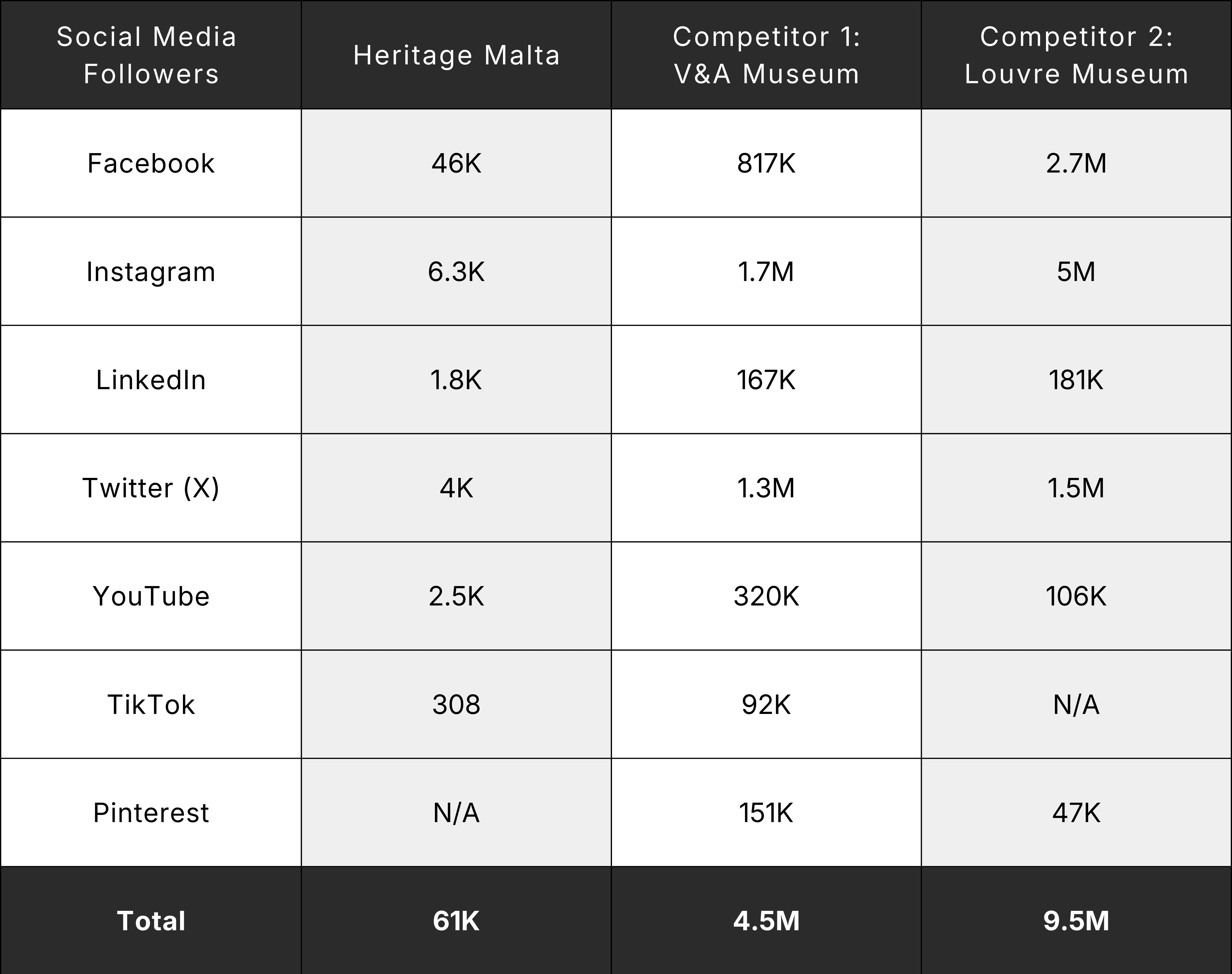
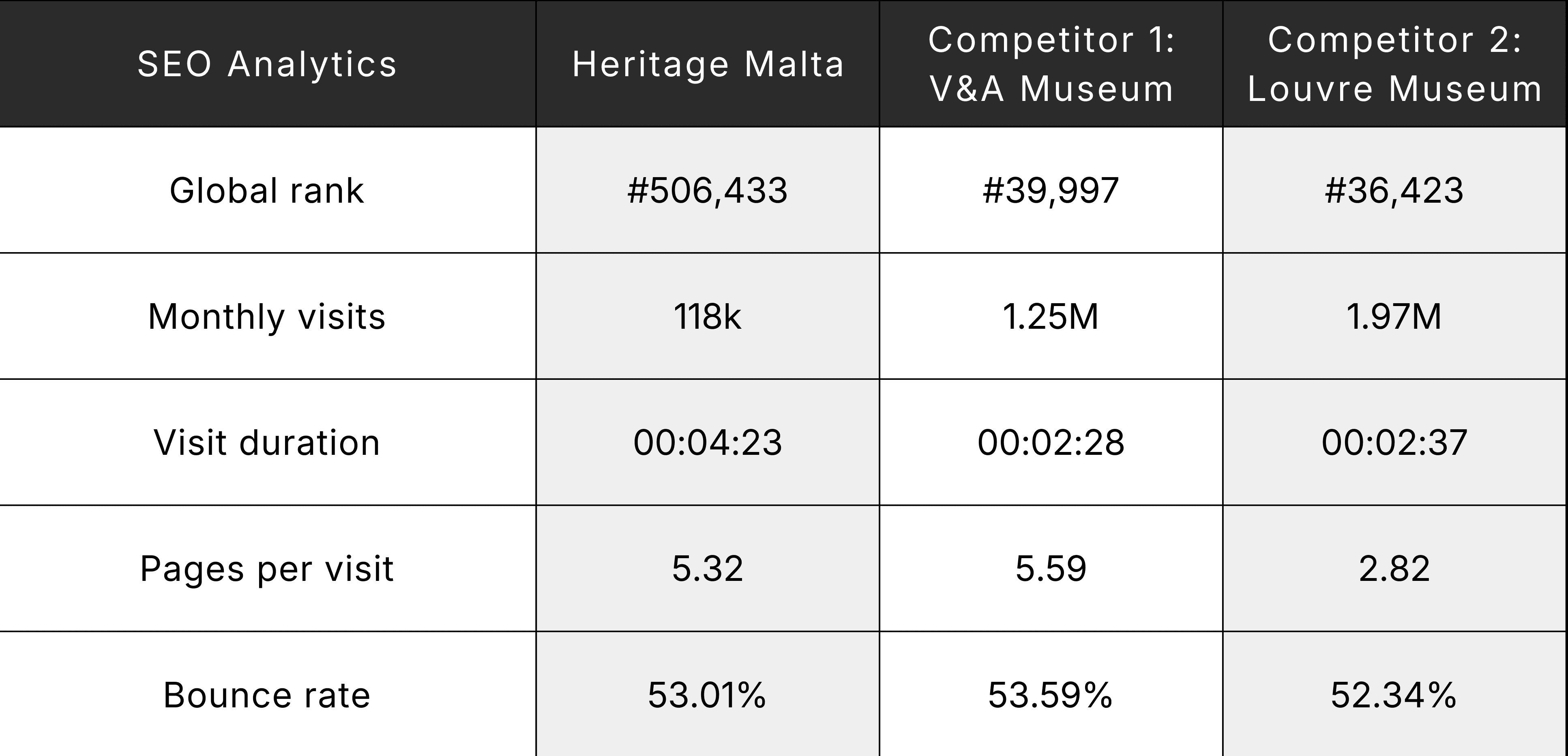
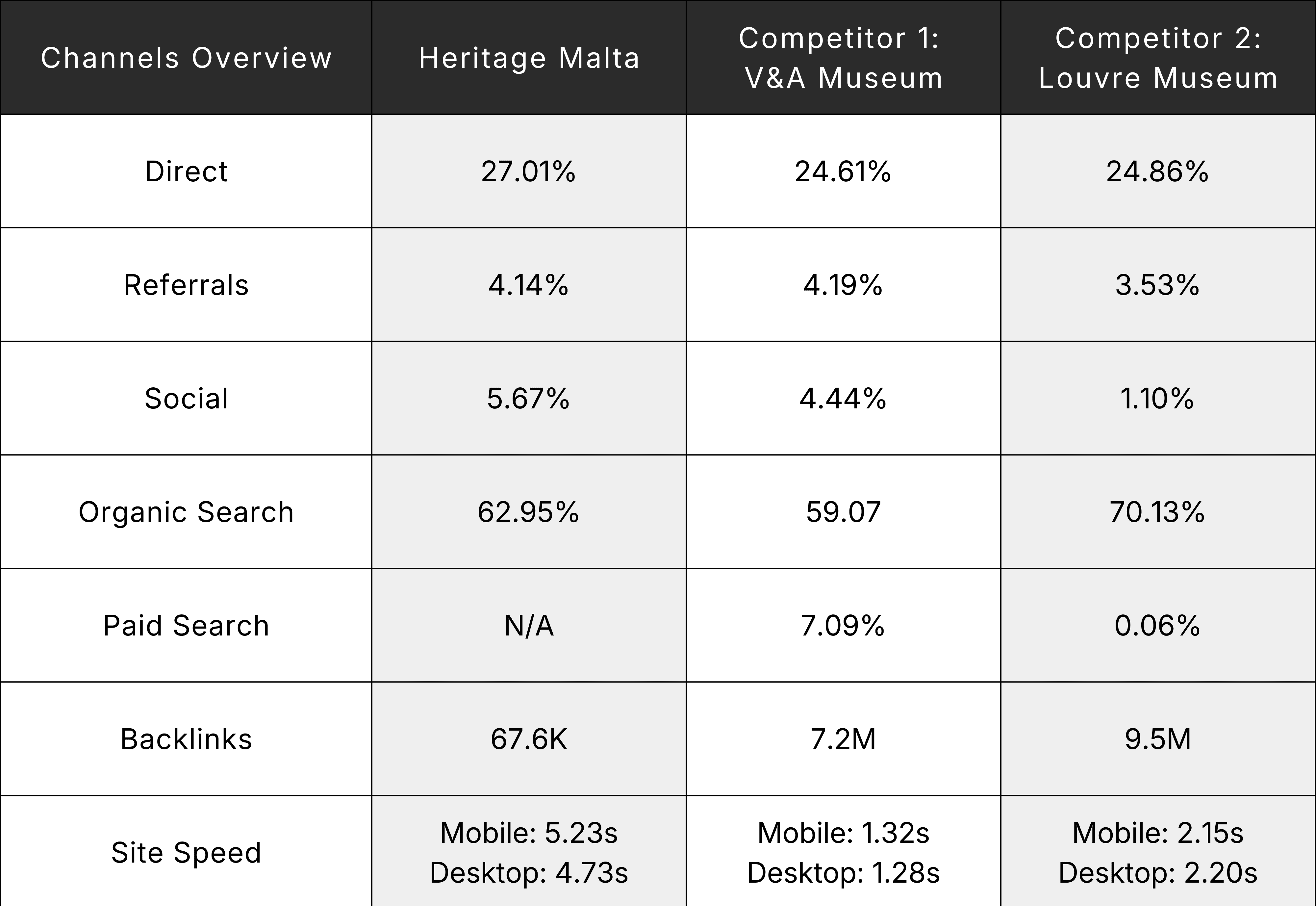
Next, a competitor matrix was developed to see how similar organisations were performing online.
Global museums like the Victoria and Albert and the Louvre set high benchmarks with millions of social media followers, strong email lists, and websites attracting huge traffic.
This comparison showed areas where Heritage Malta could differentiate itself, including social media strategy, SEO, paid advertising, and video content.
Next, a competitor matrix was developed to see how similar organisations were performing online.
Global museums like the Victoria and Albert and the Louvre set high benchmarks with millions of social media followers, strong email lists, and websites attracting huge traffic.
This comparison showed areas where Heritage Malta could differentiate itself, including social media strategy, SEO, paid advertising, and video content.
Social Media Followers
Social Media Followers
Social Media Followers
Competitor Analysis.
Competitor Analysis.
SEO Analytics
SEO Analytics
SEO Analytics
Competitor Analysis.
Competitor Analysis.
Channels Overview.
Channels Overview.
Channels Overview.
Competitor Analysis.
Competitor Analysis.
With the groundwork in place, the next step was to explore the organisation’s landscape through a SWOT and a PESTEL analysis, uncovering strengths, gaps, opportunities, and external factors shaping the path forward.
With the groundwork in place, the next step was to explore the organisation’s landscape through a SWOT and a PESTEL analysis, uncovering strengths, gaps, opportunities, and external factors shaping the path forward.
SWOT Analysis
SWOT Analysis
Strengths: high website traffic & referrals (press coverage)
Strengths: high website traffic & referrals (press coverage)
Weaknesses: low engagement & following on social media
Weaknesses: low engagement & following on social media
Opportunities: implement paid search campaigns
Opportunities: implement paid search campaigns
Threats: variable annual budget & limited trained staff
Threats: variable annual budget & limited trained staff
PESTEL Analysis
PESTEL Analysis
Political: government initiatives supporting digital tourism can offer funding/partnerships
Political: government initiatives supporting digital tourism can offer funding/partnerships
Economic: tourism trends & spending influence marketing effectiveness
Economic: tourism trends & spending influence marketing effectiveness
Social: visitor demographics & cultural trends guide content & marketing strategies
Social: visitor demographics & cultural trends guide content & marketing strategies
Technological: adoption of AR/VR can improve visitor experiences
Technological: adoption of AR/VR can improve visitor experiences
Environmental: sustainable digital content aligns with eco-conscious visitors
Environmental: sustainable digital content aligns with eco-conscious visitors
Legal: compliance with data protection regulations ensures safe visitor data use
Legal: compliance with data protection regulations ensures safe visitor data use
*This is a brief overview of the SWOT and PESTEL analysis
and does not represent the full, detailed assessment.
*This is a brief overview of the SWOT and PESTEL analysis and does not represent the full, detailed assessment.
The challenge.
The challenge.
The question was this: how to take a limited budget and small team, and turn online engagement into museum visits.
The question was this: how to take a limited budget and small team, and turn online engagement into museum visits.
How could we make social media meaningful, make email campaigns impossible to ignore, and serve
the website as a hub that drew people in?
The strategy.
The strategy.
The 6-month plan was built around the RACE Model.
We mapped the journey from awareness to loyalty for every audience. I focused on four core channels:
SEO & PPC would drive people to the website
social media would tell the story visually and encourage interaction
email marketing would maintain ongoing relationships
content marketing would support SEO, educate audiences, and inspire visits
Integrated Marketing Communications ensured that each channel spoke the same language.
Every blog post, social media story, email newsletter, and ad carried a cohesive brand message. The website acted as the hub, pulling everything together.
2 campaigns were mapped out:
tourists during the peak season
residents during local cultural events
The 6-month plan was built around the RACE Model.
We mapped the journey from awareness to loyalty for every audience. I focused on four core channels:
SEO & PPC would drive people to the website
social media would tell the story visually and encourage interaction
email marketing would maintain ongoing relationships
content marketing would support SEO, educate audiences, and inspire visits
Integrated Marketing Communications ensured that each channel spoke the same language.
Every blog post, social media story, email newsletter, and ad carried a cohesive brand message. The website acted as the hub, pulling everything together.
2 campaigns were mapped out:
tourists during the peak season
residents during local cultural events
Each campaign had goals: website visits, social engagement, email sign-ups, and ticket sales.
The 6-month plan was built around the RACE Model.
We mapped the journey from awareness to loyalty for every audience. I focused on four core channels:
SEO & PPC would drive people to the website
social media would tell the story visually and encourage interaction
email marketing would maintain ongoing relationships
content marketing would support SEO, educate audiences, and inspire visits
Integrated Marketing Communications ensured that each channel spoke the same language.
Every blog post, social media story, email newsletter, and ad carried a cohesive brand message. The website acted as the hub, pulling everything together.
2 campaigns were mapped out:
tourists during the peak season
residents during local cultural events
Each campaign had goals: website visits, social engagement, email sign-ups, and ticket sales.
Each campaign had goals: website visits, social engagement, email sign-ups, and ticket sales.
The roadmap.
The roadmap.
SEO and PPC campaigns targeted high intent keywords for each audience.
Landing pages were built to match campaigns and local listings were optimised.
Social media content focused on visual storytelling. Instagram and TikTok posts highlighted stunning sites, while hashtag campaigns encouraged visitors to share their experiences. Events were promoted through Facebook and Instagram stories & reels.
Email marketing became a direct line to the audience. Segmentation ensured content was relevant, while subject lines and visuals were tested and refined. Campaigns were fully tracked so every open, click, and conversion could inform the next step.
Content marketing tied everything together. Blog posts, interactive maps, videos, and podcasts created multiple touchpoints across channels.
Blogs were promoted on social media and in newsletters, reinforcing the journey from awareness to engagement to ticket purchase.
SEO and PPC campaigns targeted high intent keywords for each audience.
Landing pages were built to match campaigns and local listings were optimised.
Social media content focused on visual storytelling. Instagram and TikTok posts highlighted stunning sites, while hashtag campaigns encouraged visitors to share their experiences. Events were promoted through Facebook and Instagram stories & reels.
Email marketing became a direct line to the audience. Segmentation ensured content was relevant, while subject lines and visuals were tested and refined. Campaigns were fully tracked so every open, click, and conversion could inform the next step.
Content marketing tied everything together. Blog posts, interactive maps, videos, and podcasts created multiple touchpoints across channels.
Blogs were promoted on social media and in newsletters, reinforcing the journey from awareness to engagement to ticket purchase.
The projected outcome.
The projected outcome.
The strategy created a roadmap for Heritage Malta to increase engagement and museum visits.
Projections over six months included:
30% percent increase in website traffic
25% percent increase in social engagement
15% growth in email subscribers
20% increase in online ticket sales
Even without running the campaigns yet, the framework ensured that every step was measurable, optimised, and integrated.
The strategy created a roadmap for Heritage Malta to increase engagement and museum visits.
Projections over the following six months included:
30% percent increase in website traffic
25% percent increase in social engagement
15% growth in email subscribers
20% increase in online ticket sales
Even without running the campaigns yet, the framework ensured that every step was measurable, optimised, and integrated.